


 Cameron Young, Head of Financial Planning
You did what you were told to do. You maxed the RRSP, took the company match and let it compound for 30 years. The statement shows a number you are proud of.
Here is the part nobody printed on it, that number is gross, not net. Every dollar in an RRSP or a LIRA comes with a silent partner and the Canada Revenue Agency has never once forgotten what it is owed. The only open questions are when you settle up and at what rate.
Those two questions turn on something most Canadians never plan, the order in which they spend their own money.
Retirement is not a date. It is a sequence.
Most of the planning conversation in this country stops at the finish line. Can I retire at 62? Will the money last? Fair questions, but they treat retirement as one decision. It is not. It is 30 years of decisions about which account to draw from, in what amount, in which year.
Two households can hold the same portfolio, retire the same day and spend the same amount and still end up with very different tax bills. The difference is sequencing.
The gap years are the opening
The window between the day the paycheque stops and the day government benefits begin is usually the lowest-income stretch of a person’s adult life. It is also the stretch where most people leave the RRSP completely alone. That feels prudent. It is often expensive.
 Those years are room. Drawing from registered accounts deliberately while you sit in low brackets moves money out at a rate you choose, instead of a rate chosen for you later. And later is coming. In the year you turn 71 the RRSP must convert, mandatory withdrawals begin the following year on a schedule set by legislation rather than by your budget and for 2026, Old Age Security starts to be clawed back once net income passes roughly $95,000.
What that looks like in dollars
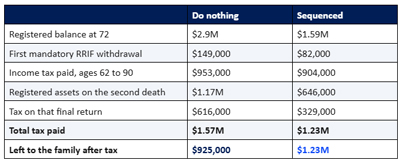
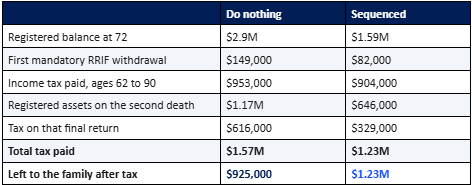
Take a couple, both 62, retiring this year with $2.6M in RRSPs and LIRAs, $200,000 in TFSAs and $400,000 in non-registered savings. They need $140,000 a year after tax. Both live to 90.
On the first path they do what most people do. They take CPP and OAS at 65, spend the non-registered money and the TFSAs first and leave the registered accounts alone until the rules force their hand.
Same couple. Same savings. Same retirement. About $336,000 less tax across the two lifetimes and roughly $309,000 more left to their family. The only thing that changed was the order.
Deferral is a planning tool, not a gamble
Delaying CPP to age 70 increases the benefit by 42 per cent. Delaying OAS adds 36 per cent. Both are indexed and both are paid for life.
The objection is fair: why give up money now? Because the bridge is funded from the portfolio and funding it does two jobs at once. It draws the registered balance down during the low-tax years and it raises the floor of guaranteed, inflation-adjusted income you cannot outlive. Whether it suits a given household depends on health, other income and the shape of the portfolio. It should be a decision, not a default.
-
Get the sequence right and the money is the same. What changes is how much of it stays yours.
The tax return nobody plans for
On the second death of a couple, whatever remains in registered accounts is generally brought into income in a single year and a lifetime of careful deferral can be taxed at the top marginal rate all at once. In the example above, that one return costs the first household about $616,000, an effective rate above 52 per cent.
That is not a reason to panic. It is a reason to plan. Melt registered assets down over decades instead of leaving them untouched. Move what you can into a TFSA. Check the beneficiary designations. Know the number now, rather than leaving your family to find it.
What to ask for
None of this is aggressive and none of it involves a product. It is timing and timing is one of the few levers in retirement you genuinely control.
Ask for a written, year-by-year withdrawal plan before you retire, not after. It should show the source of every dollar, the projected tax in each year and exactly what happens at 71 and beyond. If what you have today is a balance and a hope, you do not have a plan.
Get the sequence right and the money is the same. What changes is how much of it stays yours. If you would like to see what your own sequence looks like, book a no-cost call with us at dunbrook.ca.
